You might not be aware of how learning works. Rereading your notes over and over, highlighting and underlining, watching the lecture twice - these feel productive. The research proves different.
Science directly shows: the single biggest separator between students who understand something and students who merely recognize it is whether they pulled the idea out of their own memory and explained it out loud - before they felt ready.
The rest of the methodology - spaced repetition, interleaving, feedback (which are great) - are simply scaffolding around that one core act.
The illusion of familiarity
Rereading your notes makes you feel as if you know the material because it feels familiar. When psychologists finally ran the numbers across hundreds of studies, rereading was rated "low utility" - it consistently underperformed against every active technique in head-to-head comparisons.
Highlighting? "No benefit" beyond just reading in most controlled experiments.
The problem is that passive re-exposure builds familiarity, not understanding. And familiarity collapses the moment an exam asks you to apply, transfer, or explain.
The key distinction
Familiarity: you recognize the answer when you see it.
Understanding: you can reconstruct it, explain why it's true, and apply it to problems you've never seen before.
Only one of those is worth anything.
At AquaEdge, we want every student to build a holistic understanding of their topics - not merely recognize them.
What retrieval actually does to your brain
When researchers tested retrieval practice against restudy across dozens of experiments, the effect size landed at Hedges' g = 0.50. In a landmark 2006 experiment, students who practiced retrieval recalled 61% of material after one week. Students who restudied the same content recalled 40%.
The gap only widens with time.
Retrieval isn't just assessment. Every time you drag something out of memory - imperfectly, awkwardly, with effort - you strengthen the pathways that lead back to it. The struggle isn't a sign it's not working. It is the work.
Why you have to explain it out loud
When you're forced to articulate why something is true - not just that it is - your brain generates inferences, fills gaps, and repairs the parts of your mental model that don't actually connect. Meta-analysis of self-explanation studies puts the average effect at g = 0.55.
The critical word is forced. When learners choose whether to self-explain, most don't. When they're prompted to, they learn dramatically more. This is why a good Socratic tutor - one who won't let you move on until you've explained the mechanism - produces different outcomes than a textbook.
The real reason this is hard
Retrieval practice has one cruel irony: it often feels like it isn't working. Restudying feels fluent and easy. Retrieval feels effortful and humbling. Students consistently mispredict that rereading is more effective - right up until the test when they blank.
The strategies that produce the least comfort in the moment produce the most durable learning over time. This is what researchers call "desirable difficulty." Your brain doesn't strengthen what it retrieves easily. It strengthens what it has to fight for.
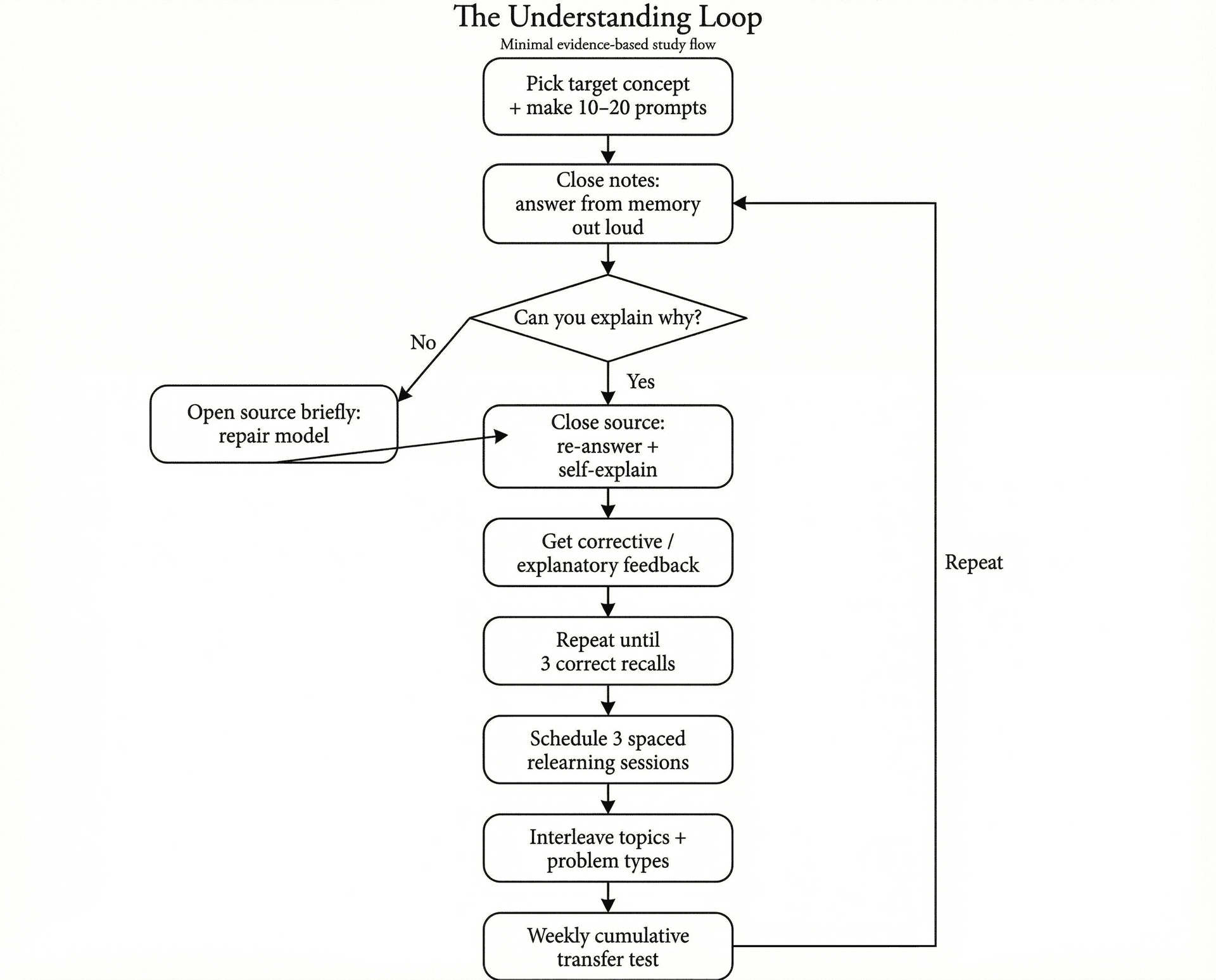
Phil is built around that fight. To make studying count.